Carbon Capture and Storage: Can Engineers Trap Climate Change?
What is carbon capture and storage?
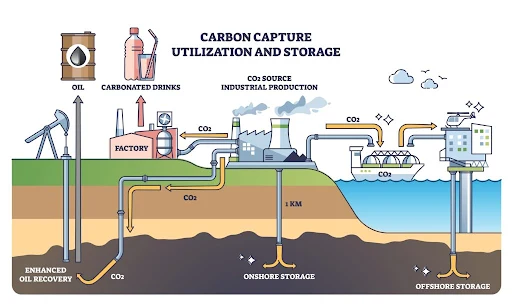
Carbon capture and storage (CCS) is a way of reducing carbon dioxide (CO2) emissions, which could be key to helping to tackle global warming. It’s a three-step process, involving: capturing the CO2 produced by power generation or industrial activity, such as hydrogen production, steel or cement making; transporting it; and then permanently storing it deep underground.
How does CCS actually work?
There are three steps to the CCS process:
1. Capturing the CO2 for storage
The CO2 is separated from other gases produced in industrial processes, such as those at coal and natural-gas-fired power generation plants or steel or cement factories.
2. Transport
The CO2 is then compressed and transported via pipelines, road transport or ships to a site for storage.
3. Storage
Finally, the CO2 is injected into rock formations deep underground for permanent storage.
Types of Carbon Capture
Several different technologies can be used to capture CO₂ at the source (the facility emitting CO₂). They fall into three categories: post-combustion carbon capture (the primary method used in existing power plants), pre-combustion carbon capture (largely used in industrial processes), and oxy-fuel combustion systems. For post-combustion carbon capture, CO₂ is separated from the exhaust of a combustion process. For pre-combustion capture technologies, there are commercially available technologies used by industrial facilities; however, for power plants, pre-combustion capture is still in early stages of development. This technology involves gasifying fuel and separating out the CO₂. It may be less costly than other options; however, it can only be built into new facilities—to retrofit an existing facility for pre-combustion capture would be prohibitively costly. For oxy-fuel combustion, fuel is burned in a nearly pure-oxygen environment, rather than regular air, which results in a more concentrated stream of CO₂ emissions, which is easier (and cheaper) to capture.
Environmental engineers in CCS
Environmental engineers play a vital role in this process by developing efficient capture technologies, ensuring the safety of storage sites, and improving the overall cost-effectiveness of CCS systems. While CCS offers significant potential for reducing emissions, especially from industries that are difficult to decarbonize, challenges remain. The technology is still costly, energy-intensive, and requires long-term monitoring to prevent leaks. Despite these hurdles, CCS has already shown promise in projects like the Sleipner Project in Norway and Boundary Dam in Canada, demonstrating its potential as a critical tool for reducing global CO₂ emissions and mitigating climate change.
Benefits and Challenges
Carbon Capture and Storage (CCS) offers significant benefits in the fight against climate change. It allows for the reduction of CO₂ emissions from hard-to-decarbonize sectors, such as cement and steel production, and can help mitigate emissions from fossil fuel-based power plants. CCS also holds the potential to create negative emissions when combined with bioenergy (BECCS), removing CO₂ from the atmosphere. However, there are notable drawbacks. The technology is currently expensive, requiring substantial investment for capture, transportation, and storage infrastructure. Additionally, the process consumes a considerable amount of energy, which can offset some of its benefits. Long-term storage safety is another concern, as any leakage of stored CO₂ could undermine its effectiveness and potentially harm the environment. Despite these challenges, CCS remains a promising tool for addressing climate change, especially when used alongside other mitigation strategies.
Conclusion
In conclusion, Carbon Capture and Storage (CCS) represents a critical technology in the global effort to combat climate change. By capturing CO₂ emissions from industries and power plants, transporting them, and storing them safely underground, CCS has the potential to significantly reduce greenhouse gas emissions, especially from hard-to-decarbonize sectors. However, its high cost, energy consumption, and long-term storage concerns pose challenges that need to be addressed for it to become a widely adopted solution. Despite these hurdles, CCS, when combined with other strategies like renewable energy and energy efficiency, could play a vital role in mitigating the impacts of climate change, helping pave the way for a more sustainable future.
Sources:
https://www.gexcon.com/blog/co2-hazards-in-carbon-capture-utilisation-and-storage-ccus/
https://www.nationalgrid.com/stories/energy-explained/what-is-ccs-how-does-it-work
https://arroyogeo.com/role-environment-engineering-climate-change-mitigation/